Showing posts with label spring. Show all posts

Monday, June 20, 2011

Fennel Bulbs au Gratin


Halved, steamed in a pressure cooker for a few minutes, then placed in a buttered pyrex dish, sprinkled with butter and grated Gruyère cheese, under the broiler for 5 minutes.

Sunday, June 19, 2011

Lemon chicken with olives, in a tomato sauce, with yellow chard


Two of our closest friends moved to New Zealand last summer for a year and we were fortunate enough to visit them last month. It was so nice to spend some time with them and to discover this beautiful country (our first time south of the Equator!).

To welcome us, our friends prepared an amazing tajine dish* of chicken, green olives and preserved lemons (not exactly a typical Kiwi dish, but rather a nice reminiscence of our friend's childhood in North Africa). I must have had this dish in mind when I pulled ingredients out of the fridge the other night and prepared the chicken dish that follows.

Serves 4
  • 4 whole chicken legs
  • 1/2 jar (12 oz) strained tomatoes
  • about 20 olives
  • juice of 2 lemons
  • 4 thin slices of pancetta, diced
  • 1 cup white wine (Chardonnay or Pinot Grigio)
  • 2 cloves garlic, peeled and halved, stem removed
  • 1 bunch yellow chard leaves, whole or coarsely chopped
  • 1 tbsp olive oil
  • salt and freshly ground black pepper
I like whole (non pitted) kalamata or mixed Greek olives, in bulk (not canned). For chicken, I always go organic since chicken is cheap anyway. Same with lemons.

Marinate the chicken legs in lemon juice for about 1/2 hour or simply until the other ingredients are ready (chard washed, pancetta diced, etc.)

Heat the olive oil in a heavy bottom pan or a cocotte. Add the diced pancetta and let it color for a few minutes. Set aside. Drain excess fat from the pan if necessary.

Drain the chicken legs (keep the marinade). Season the chicken legs with salt and pepper, then add them to the pan. Brown on every side.

Add the strained tomatoes, lemon juice marinade, olives, pancetta, garlic, and white wine. Stir. Bring to a simmer and cook, covered, for about 1/2 hour.

Move the chicken legs to one side of the pan then plunge the chard leaves in the tomato sauce. Stir until wilted (2 minutes maximum).

Serve with wild rice or bulghur (cracked wheat).

* Our friends' recipe more authentically Mediterranean than the above week-night "invention", and includes olive oil, onions, garlic, and most importantly ras el hanout (a North African spice blend).


Wednesday, May 25, 2011

A few pictures...


Barbecue-grilled beef tri-tip
 Tokyo turnips, braised in butter
Bok choy sautéed in sunflower oil with green garlic, in a wok


Flashy English peas and carrots from my weekly organic vegetable box


Lemon chicken with olives, in a tomato sauce, with yellow chard
(recipe coming up...)

Sunday, April 24, 2011

Yogurt Dip


Yesterday we were invited to a potluck Easter egg hunt party, and I remembered about the potluck part of it about five minutes before leaving. Thankfully we had all the ingredients I needed for a quick yogurt dip. I combined the ingredients listed below in a glass jar, cut up young and juicy carrots from our organic CSA box into strips, and I even got the time to take a picture! Now that's fast...
  • 1 6-oz (170 g) plain yogurt (Clover organic for instance)
  • 1 lemon (or Meyer lemon), juiced
  • 1 clove garlic, pressed
  • 1 tablespoon cumin seeds, crushed
  • salt

This also makes a great sauce for grilled lamb chops.

A few years ago I blogged about my childhood Easter memories.

Wednesday, April 13, 2011

Lemon Marmalade


Are Meyer lemons and navel oranges still in season? They were a couple weeks ago. Trees in our neighborhood were bending under the weight of hundreds of brightly colored fruits. A friend brought us a bag full of them, picked up in her backyard that very morning. And what do you do with citrus that has been lucky enough to grow without pesticides? Eat them with the skin! I made lemon marmalade that weekend (and brought a jar to my friend as a thank you gift), using a recipe from my mother-in-law*.

For about 8 jars
(I often reuse empty 13-ounce Bonne Maman jars.)
  • 6 Meyer lemons (organic or pesticide-free)
  • 2 navel oranges (organic or pesticide-free)
  • 1.5 kg (6 cups) sugar
  • 1 liter (about 1 quart) water
 

Day 1
  1. Rinse the fruits under running water. Pat them dry.
  2. Cut them in 4 lengthwise, then take the seeds out and place them on a square of cheese cloth that you tie with a string (in French it is called un noué). If you don't have cheese cloth, you can put the seeds in a tea ball.
  3. Thinly slice each fruit quarter (about 3-5 mm or 1/8-1/5 " in thickness).
  4. Place the fruit slices and the pocket of seeds in a large pot (I use my pressure cooker without closing it, althouth une bassine à confiture—a jam pan—would be more authentic...). Pour 1 quart (about 1 liter) water on the fruits. Place a lid on the pot.
  5. Wait for 24 hours.
Day 2
  1. Place the pot or pan on the stove on medium-high heat, lid on. Boil for 50 minutes. Turn off the heat.
  2. Wait for 24 hours.
Day 3
  1. Find 8 or 9 empty glass jars with lids. Clean them if necessary and boil them in water for 5 minutes to sterilize them. Let them dry on a clean dish cloth.
  2. Open the pot or pan and remove the pocket of seeds. Pour the sugar and stir until it dissolves in the fruit juice.
  3. Bring to a boil and cook without lid for about 35 minutes.
  4. Use a ladle to pour the hot marmalade in the jars. Fill the jars up to the bottom of their rim. Close immediately. As the jam cools down, the air inside the jar will retract and the lid will pop. Store the marmalade for up to one year in a kitchen cabinet (or a cellar if you have one). Refrigerate after opening.
I use this marmalade just as any other jam, spread on whole wheat walnut bread for breakfast.

* I actually modified the recipe a little bit. Gisèle uses 12 true lemons, 2 oranges, and 1 peeled grapefruit with 2 liters of water and 3 kg (12 cups) of sugar. Her recipe yields about 16 jars. Since Meyer lemons are sweeter than true lemons, the grapefruit wasn't really necessary in my case.


Thursday, March 3, 2011

Artichoke!


Simply boiled and eaten warm, leaf after leaf, with vinaigrette until getting to the best part–the heart. Yum!

Friday, May 21, 2010

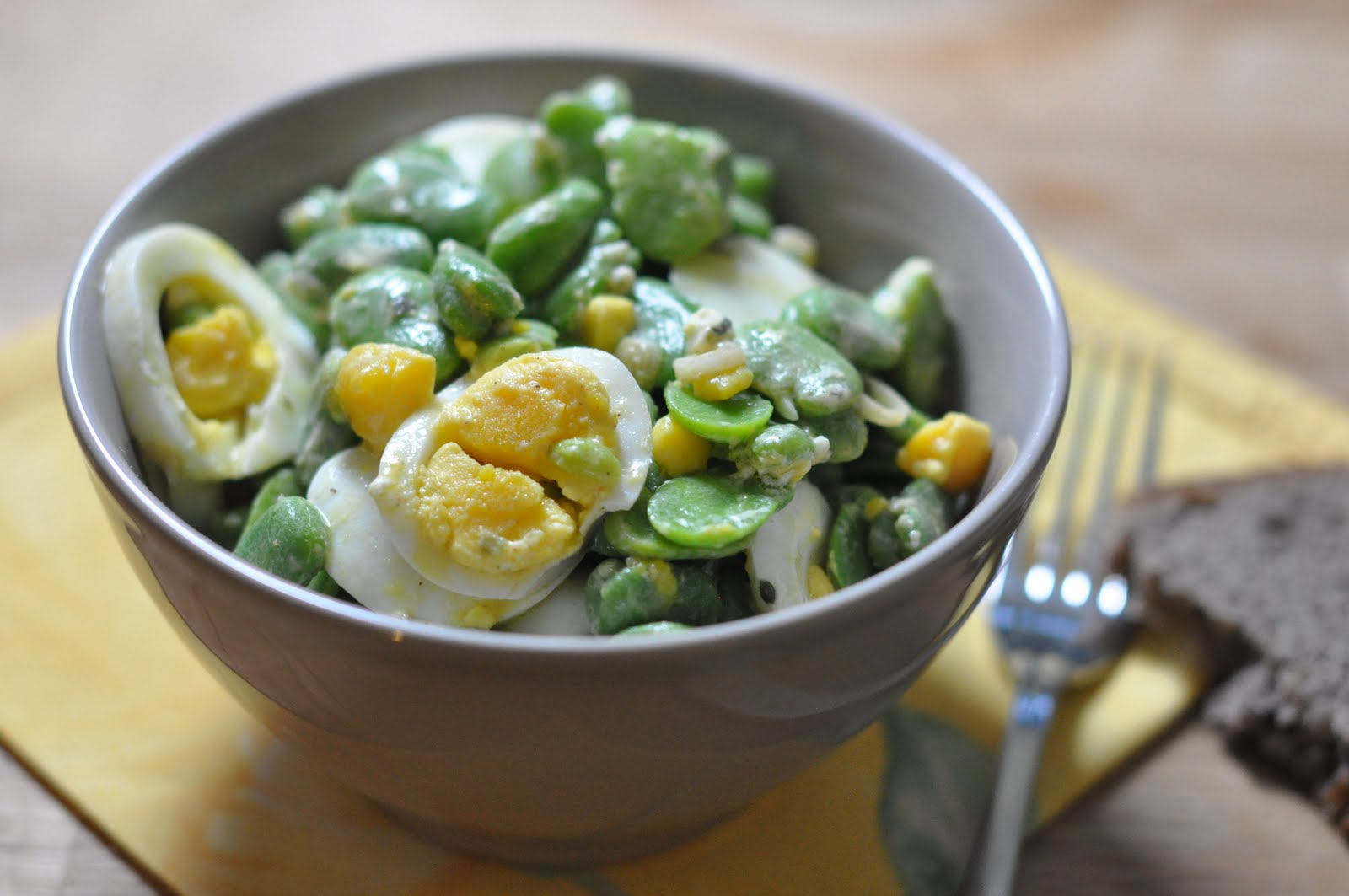
Fava bean and egg salad

As a scientist I can't help myself but weigh fava beans before and after shelling them every time they cross my path. I had blogged about the experiment here already. And yesterday as usual I took my scale out. This time we had 3 pounds of pods, 1 pound 4 ounces of beans with skin and just under 14 ounces of beans once skinned (28% of the pods' weight). We had enough for 3 generous servings.


The following recipe is inspired by this one, from Marmiton.org.
  • 3 lbs fresh fava beans (in pods)
  • 2 sprigs thyme or savory
  • 3 brown eggs
  • 3 calçot onions (or green onions)
  • 2 to 3 oz (60 to 85 g) goat cheese*
  • 1 tbsp Banyuls vinegar (or sherry vinegar)
  • 2 tbsp olive oil
  • salt and pepper
  1. Boil the eggs for 10 minutes then plunge them in cold water.
  2. Remove the dark leaves and the outer skin of the onions and slice them thinly. Place them at the bottom of a salad bowl and cover with 1 tablespoon vinegar.
  3. Shell the fava beans. Boil them with thyme (or savory) in salted water for 5 minutes, then plunge them in cold water to stop the cooking. Pop the beans out of their pale green skin. Place them in the salad bowl.
  4. Peel and slice the eggs. Add them to the salad along with the cheese, shaved or diced depending on how hard it is.
  5. Season with salt, pepper and 2 tablespoons olive oil. Toss.
  6. Serve or refrigerate.
* I used a fresh California goat cheese rolled in herbs that I had handy. I think a hard goat or sheep cheese would work even better.